ANSI flanges are standard components in piping systems worldwide. They connect pipes, valves, and equipment with predictable, reliable results.
This guide explains the ANSI sizing system, the key dimensions you need to know, and how to specify the correct flange for your application.
What is an ANSI Flange?
“ANSI Flange” refers to a flange manufactured to the dimensional standards set by the American National Standards Institute (ANSI). Specifically, the standard for most industrial pipe flanges is ASME B16.5. This standard ensures that a Class 150, 2-inch flange from one manufacturer has the exact same bolt pattern and dimensions as the same flange from another supplier.
These flanges are categorized by two primary identifiers:
- Nominal Pipe Size (NPS): The size of the pipe the flange connects to, such as NPS 2″ or NPS 12″.
- Pressure Class (or Rating): A number like 150, 300, or 600. This is not the working pressure in PSI, but a class rating that indicates the flange’s pressure-temperature capacity. A higher class can handle higher pressures at a given temperature.
ANSI Flange Pressure Classes and Sizes
The ASME B16.5 standard covers flanges in pressure classes from 150 to 2500, for pipes ranging from NPS 1/2″ to NPS 24″. The most common classes are 150, 300, 400, and 600.
Selecting the right class depends on your system’s operating pressure and temperature. This chart shows the general decision process:
For large-diameter pipes (NPS 26″ and above), the governing standard is ASME B16.47.
Key Flange Types and Their Uses
The ASME B16.5 standard defines dimensions for several flange types, each suited for different jobs.
| Flange Type | How It Connects | Best For | Notes |
| Weld Neck (WN) | Butt-welded to the pipe. | High-pressure, high-temperature, or critical service. The strongest connection. | The hub provides excellent stress distribution. |
| Slip-On (SO) | Slides over the pipe and is welded inside and out. | Lower pressure applications, easier alignment, cost-sensitive projects. | Requires two fillet welds. |
| Blind (BL) | Has no bore; bolts to another flange to close a line. | Isolating or sealing the end of a piping system. | Must match the pressure class of the mating flange. |
| Lap Joint (LJ) | Pairs with a Stub End (welded to the pipe). The flange itself is loose. | Systems requiring frequent disassembly or alignment of bolt holes. | The stub end contacts the fluid, allowing the backing flange to be a cheaper material. |
| Threaded | Screws onto a pipe with external threads. | Low-pressure systems where welding is not possible or desired. | Not suitable for high vibration or thermal cycling. |
| Socket Weld (SW) | Pipe inserts into a socket and is fillet welded. | Small-diameter, high-pressure piping. | Provides smooth flow and good strength. |
Critical ANSI Flange Dimensions
When you look at a flange drawing or chart, these are the most important dimensions.
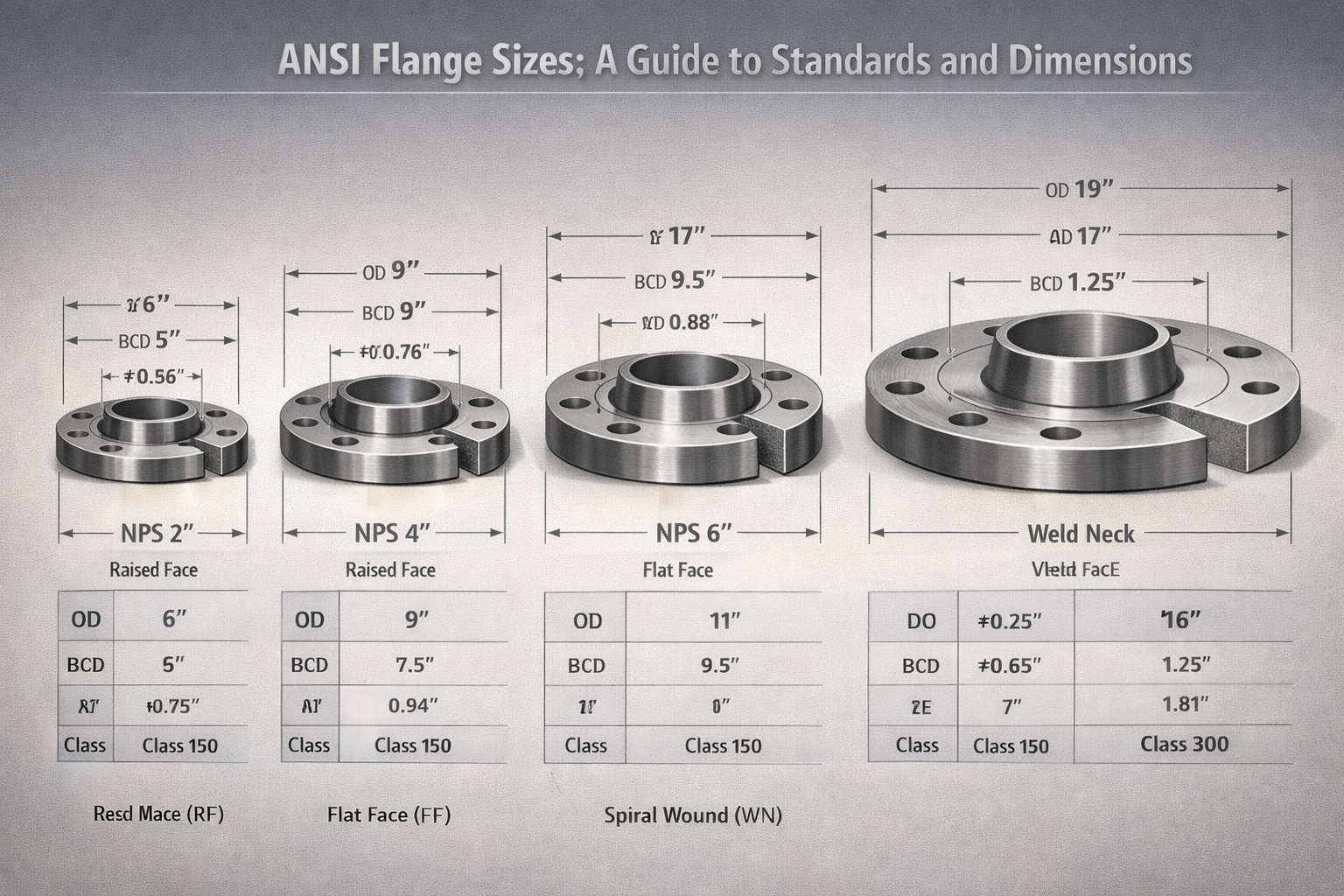
- Outside Diameter (O.D.): The total width of the flange.
- Thickness: The thickness of the flange body.
- Bolt Circle Diameter (B.C.D.): The diameter of the circle that passes through the center of all bolt holes. This must match perfectly on mating flanges.
- Number & Size of Bolt Holes: Determines the number and diameter of stud bolts needed.
- Bore: The inner diameter. For weld neck flanges, this must be machined to match the specific pipe wall thickness (schedule).
Example Dimensions: ASME B16.5 Class 150 & 300 (Select Sizes)
All dimensions are in inches.
| NPS | Class 150 O.D. | Class 150 Bolt Circle | Class 150 # Bolts | Class 300 O.D. | Class 300 Bolt Circle | Class 300 # Bolts |
| 2″ | 6.00 | 4.75 | 4 | 6.50 | 5.00 | 8 |
| 4″ | 9.00 | 7.50 | 8 | 10.00 | 7.88 | 8 |
| 6″ | 11.00 | 9.50 | 8 | 12.50 | 10.62 | 12 |
| 10″ | 16.00 | 14.25 | 12 | 17.50 | 15.25 | 16 |
Note: As pressure class increases, the flange gets thicker, the outside diameter grows, and more/larger bolts are required to maintain the seal.
Frequently Asked Questions
Q: Is “ANSI Class 150” the same as 150 PSI working pressure?
A: No. The class number (150, 300, etc.) is a pressure-temperature rating. A Class 150 flange can handle much higher pressures at ambient temperatures. You must consult the ASME B16.5 pressure-temperature rating tables for the exact maximum working pressure based on your material and temperature.
Q: Are ANSI flanges used outside the United States?
A: Yes. ANSI/ASME B16.5 is an international standard. Equivalent metric standards like ISO 7005 or EN 1092 have “PN” (Pressure Nominal) ratings that are designed to be interchangeable with ANSI classes (e.g., Class 150 is similar to PN20).
Q: What’s the most important thing to check when matching two flanges?
A: The Bolt Circle Diameter (B.C.D.). If the B.C.D. doesn’t match exactly, the bolt holes will not align, and the flanges cannot be connected.
Q: Do I need to consider the pipe schedule when ordering a flange?
A: Yes, especially for weld neck flanges. The flange’s bore must be machined to match the outer diameter of your specific pipe schedule (e.g., Schedule 40 or 80) for a proper fit and weld.
Conclusion
Specifying the correct ANSI flange means providing three key pieces of information: the Nominal Pipe Size (NPS), the Pressure Class, and the Flange Type. Using the standardized dimensions of ASME B16.5 ensures safety, prevents leaks, and guarantees that components from different manufacturers will fit together.
Need help identifying or sourcing the correct ANSI flange for your specific pressure, temperature, and application requirements? Our technical team can help you navigate the specifications and provide flanges that meet exact ASME B16.5 standards. Submit your project details for a quote: http://texasflange.com/lp12/